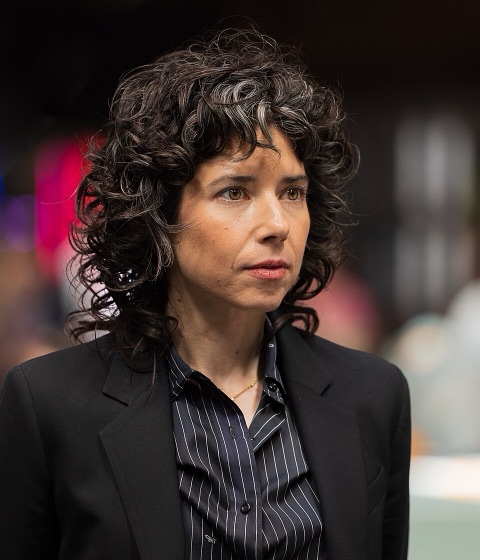
Photo: Martin Kraft, via Wikimedia Commons, CC BY-SA 4.0
Policy & Ethics
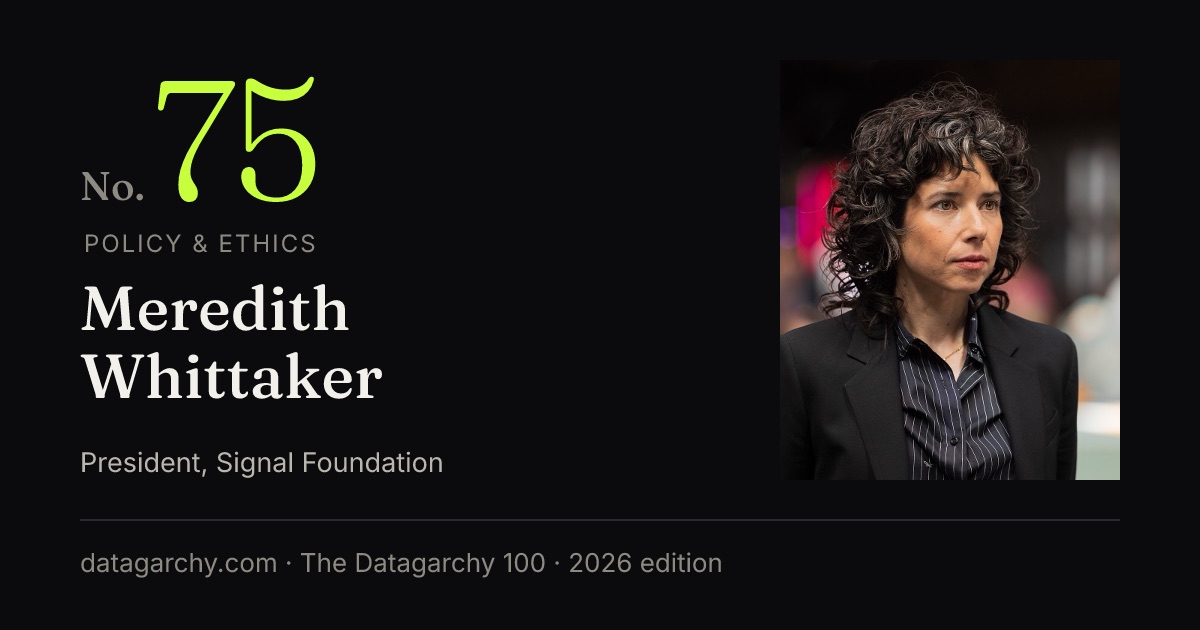
Meredith Whittaker
President, Signal Foundation
From Google whistleblower to Signal president, the loudest advocate for keeping data out of corporate and government hands.
Score 79/100
Published · Last reviewed
Why they’re on the list
Whittaker leads Signal, the leading privacy-preserving alternative to data-hungry messaging platforms, and remains one of the most influential public critics of surveillance-driven AI and platform data practices.
Meredith Whittaker is president of the Signal Foundation, which oversees the end-to-end encrypted messaging app used by hundreds of millions of people. Signal is the leading privacy-preserving alternative to data-hungry messaging platforms. It is one of the few large-scale technology organisations explicitly built to minimise data collection rather than maximise it. Before Signal, Whittaker spent thirteen years at Google and co-founded the AI Now Institute at New York University. She was also a central organiser of the 2018 Google Walkouts. For two decades she has pushed against a default assumption of the modern data economy. That assumption is that platforms are entitled to collect, analyse and monetise everything about their users. She remains one of the most influential public critics of surveillance-driven AI and platform data practices.
At Google, Whittaker founded the company's Open Research group and co-founded M-Lab. That global network-measurement project became one of the largest open datasets on internet performance. Her time there culminated in the 2018 Walkouts, which mobilised some 20,000 employees. They protested the company's handling of sexual misconduct allegations and its involvement in the Pentagon's Project Maven programme. She left Google in 2019, citing retaliation.
In parallel, Whittaker co-founded AI Now with Kate Crawford in 2017. It was one of the first research centres dedicated to examining the social implications of artificial intelligence. Its work covered algorithmic bias, labour impacts and the concentration of AI infrastructure among a handful of large firms. That work made her a sought-after voice on AI policy. From 2021 to 2022 she served as a senior adviser on AI to then-FTC Chair Lina Khan. She has also testified repeatedly before the US Congress on facial recognition and AI ethics.
Whittaker took the presidency of the Signal Foundation in September 2022. Since then she has become one of the most visible global defenders of encryption. She has repeatedly warned governments in the US, UK and EU against legislation that would weaken end-to-end encryption in the name of public safety. She frames encrypted, minimal-data messaging as a direct counter-model to surveillance-driven business practices. She spent her Google career observing those practices from the inside.
Whittaker's influence rests on a rare combination. She has technical credibility from years inside a data-hungry tech giant and academic standing from AI Now. She now also holds institutional power atop Signal. That gives her both the platform and the product to argue that a less extractive data economy is technically achievable, not just desirable.
Career timeline
- 2006Joins Google; later founds Google Open Research
- 2017Co-founds the AI Now Institute at NYU
- 2018Helps organise the Google Walkouts
- 2019Leaves Google
- 2021Serves as senior adviser on AI to FTC Chair Lina Khan
- 2022Becomes President of the Signal Foundation
- 2023Named to TIME's 100 Most Influential People in AI