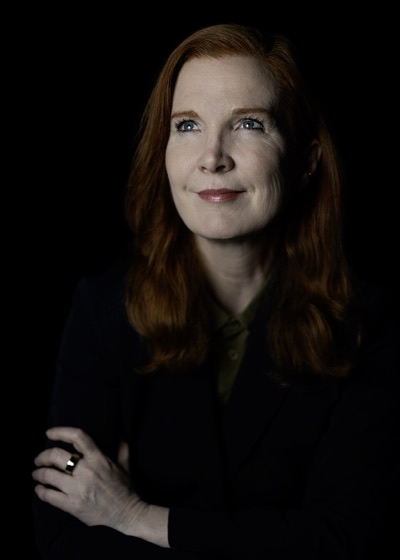
Photo: Cmichel67, via Wikimedia Commons, CC BY-SA 4.0
Policy & Ethics
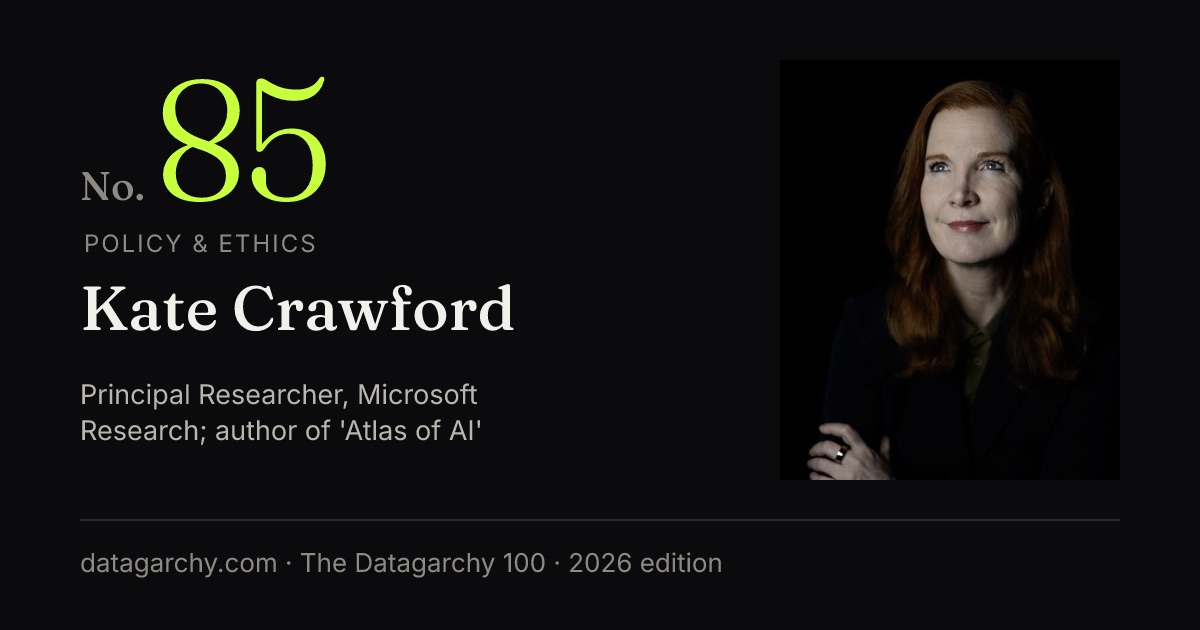
Kate Crawford
Principal Researcher, Microsoft Research; author of 'Atlas of AI'
Mapped the hidden labour, minerals and data extraction behind every AI system.
Score 76/100
Published · Last reviewed
Why they’re on the list
Crawford's research, especially 'Atlas of AI', reframed global debate on data and AI as questions of extraction, labour and planetary cost rather than pure computation, shaping policy discourse worldwide.
Kate Crawford is a principal researcher at Microsoft Research and the author of 'Atlas of AI'. The Australian academic's work has reframed how policymakers, journalists and technologists understand the material costs of artificial intelligence and the data infrastructures that power it. Her 2021 book recast debate on data and AI as questions of extraction, labour and planetary cost rather than pure computation. In 2017 she co-founded the AI Now Institute at New York University, one of the first dedicated academic centres researching the social implications of AI. Her projects with Vladan Joler, 'Anatomy of an AI System' and 'Calculating Empires', have won major design and art prizes. She is one of the most cited voices arguing that AI systems must be understood as extractive industries.
Crawford has spent over a decade examining how AI systems encode power, labour and environmental extraction. That work culminated in her widely acclaimed book 'Atlas of AI: Power, Politics, and the Planetary Costs of Artificial Intelligence'. The book traces the physical supply chain behind seemingly abstract data systems. It runs from lithium mining and rare-earth extraction to the vast, energy-hungry data centres that train and run large-scale models. It also covers the low-paid human labour required to label and moderate training data.
'Atlas of AI' became one of the most influential works in AI policy circles. It shifted debate away from purely abstract algorithmic ethics toward the concrete environmental and human costs of building AI at scale.
Crawford co-founded AI Now with Meredith Whittaker. The institute helped define the field of AI policy research that now informs regulation from Brussels to Washington. Her earlier collaborative project 'Anatomy of an AI System' mapped the full resource chain of an Amazon Echo device. It won the Beazley Design of the Year award in 2019.
Crawford holds a PhD from the University of Sydney. She has held visiting and advisory positions, including the inaugural AI and Justice Visiting Chair at the École Normale Supérieure in Paris. Her more recent project 'Calculating Empires' is a large-scale visual history of AI and power. It won the European Commission's Grand Prize in Artistic Exploration in 2024 and a Silver Lion at the Venice Biennale of Architecture in 2025.
Through both scholarly research and public-facing art and advocacy, Crawford argues that data and AI systems carry real environmental and human costs. Her work has influenced how governments and companies now approach AI governance and sustainability reporting.
Career timeline
- 2017Co-founds the AI Now Institute at NYU with Meredith Whittaker
- 2019'Anatomy of an AI System' wins Beazley Design of the Year
- 2019Appointed inaugural AI and Justice Visiting Chair, École Normale Supérieure
- 2021Publishes 'Atlas of AI'
- 2024'Calculating Empires' wins European Commission Grand Prize in Artistic Exploration
- 2025'Calculating Empires' receives Silver Lion at Venice Biennale of Architecture