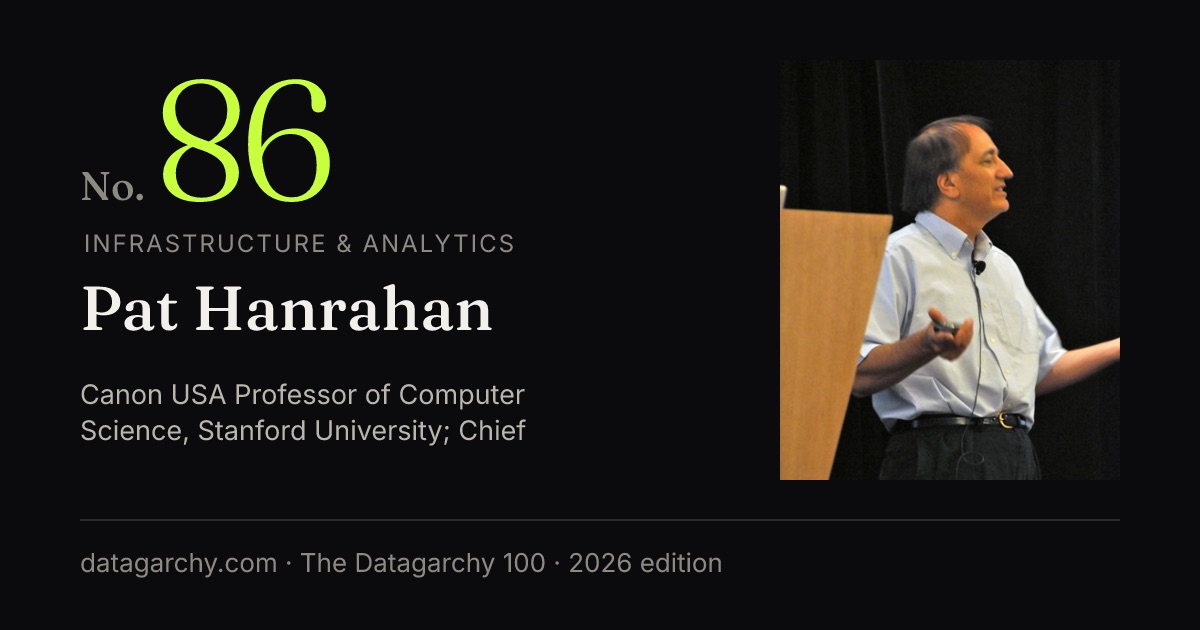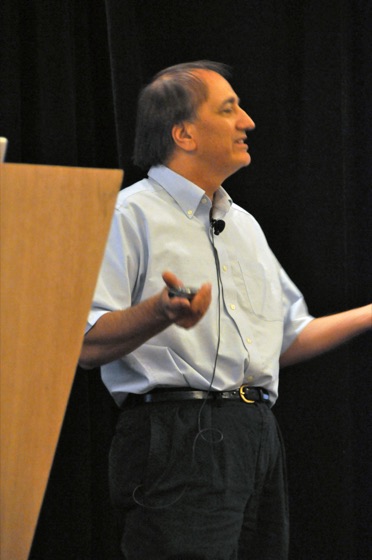
Photo: Francois Lamotte from Belgium, via Wikimedia Commons, CC BY 2.0

Infrastructure & Analytics
Pat Hanrahan
Canon USA Professor of Computer Science, Stanford University; Chief Scientist and co-founder, Tableau Software
Turing Award computer graphics pioneer whose research underpins both Pixar's rendering and Tableau's visual analytics.
Score 76/100
Published · Last reviewed
Why they’re on the list
Pat Hanrahan's research created the visual and technical foundations for Tableau Software, reshaping how the world explores and understands data, on top of a parallel legacy in computer-generated film imagery recognised with a Turing Award.
Patrick M. (Pat) Hanrahan is a professor at Stanford University, co-founder and chief scientist of Tableau Software, and a winner of the ACM A.M. Turing Award. His work sits at the foundation of two industries: cinematic computer graphics and modern data visualisation. As a founding employee of Pixar, he helped develop the RenderMan rendering system and shading language. At Stanford, his research on visual analytics became the technical basis for Tableau, which he co-founded in 2003. That research created the visual and technical foundations for a product that reshaped how the world explores and understands data. Salesforce acquired Tableau in 2019 for roughly $15.7 billion. The same year he shared the Turing Award with Ed Catmull, recognising his parallel legacy in computer-generated film imagery.
The Turing citation honoured 'fundamental contributions to 3-D computer graphics, and the revolutionary impact of these techniques on computer-generated imagery (CGI) in filmmaking and other applications.' The award is computing's highest honour.
Hanrahan earned a bachelor's degree in nuclear engineering, followed by a master's and PhD in biophysics, all from the University of Wisconsin–Madison. He began his career in computer graphics research at the New York Institute of Technology and Digital Equipment Corporation. He joined Pixar Animation Studios in 1986. There, RenderMan became the industry standard for photorealistic computer-generated imagery in film.
After a faculty position at Princeton, Hanrahan moved to Stanford in 1995. His Computer Graphics Laboratory produced influential work on GPU programming and scientific visualisation. Crucially, it also worked on visual analytics — research into how people perceive and interact with graphical representations of data. That research, alongside PhD student Chris Stolte and entrepreneur Christian Chabot, led to Tableau.
Tableau commercialised Hanrahan's academic work on 'VizQL', a visual query language. It let users construct database queries by dragging and dropping fields onto a canvas, instantly generating charts and dashboards. The company went public in 2013. Its sale to Salesforce made Hanrahan's dual legacy — in film rendering and in business intelligence — one of the more unusual and consequential in modern computing.
Hanrahan holds three Academy Awards for his contributions to rendering technology used throughout the film industry. He is a member of the US National Academy of Engineering. He is also a fellow of the American Academy of Arts and Sciences and the ACM. He continues to lead research and teaching at Stanford, mentoring the next generation of graphics and visualisation researchers.
Career timeline
- 1985Earns PhD in biophysics from University of Wisconsin–Madison
- 1986Joins Pixar as a founding employee; helps develop RenderMan
- 1995Joins Stanford University faculty, founding its Computer Graphics Laboratory research on visualisation
- 2003Co-founds Tableau Software with Christian Chabot and Chris Stolte
- 2013Tableau goes public on the NYSE
- 2019Shares the ACM A.M. Turing Award with Ed Catmull
- 2019Salesforce acquires Tableau for approximately $15.7 billion